I posted this on facebook a while ago, and realised that I wanted it to be in a more “permanent” storage and referral space….
“I’ve been thinking for a while now about the invisible doorways which some of us move through so freely, and others bang into, time and time again, or don’t actually bang into because they can see CLEARLY the door closed to them and so obviously open to me.
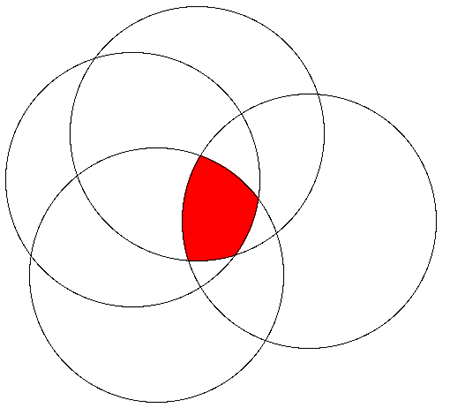
There is a helpful concept which has made me so much more aware of the world through which I move, called “intersectionality” – it draws attention to various dimensions and degrees of privilege, discrimination or oppression, and particularly how some forms of privilege or oppression become exponentially stronger as the “intersect” with each other, automatically giving some people huge power as they enter a room, and rendering others less powerful or powerless.
My privilege in South Africa doesn’t just come from the colour of my skin. Here are some other things which make those doorways SO much easier for me to navigate than others:
- I speak the dominant language of communication in our country – as my mother tongue and with a specific accent which people “respect”; I was also educated in my home language
- I am a citizen of the country in which I live;
- I am able-bodied;
- Although I am a woman (being born a male would have given me immediate unseen privileges), I also belong to culture which usually sees women as able to occupy the same positions and roles in the world as men;
- I am “cisgender” – which means that my biological sex matches my identity and expression of my gender;
- I am heterosexual and therefore am not questioned about my attraction to my partner;
- I was born into a class which immediately gave me better access to nutrition, health care, early childhood stimulation and schools
What else am I missing? Where else have you recognised doors and wide-open doorways?”
I really enjoyed the richness of the comment section:
 And then I saw this this week, which I had actually written into a “how to facilitate” worksheet for a week in our staff time which we didn’t use, so I was very glad to have a way to share this exercise visually and how people experience it…(Although I would add that I think it was sad that this exercise only had people who were able bodied – or able to walk – and that the audio instructions weren’t backed up by visual aids – some more bits of where we are privileged! What else can you see that they have missed out?)
 From the Outer Limb
Pingback: “White men should learn in silence and submission” – From the Outer Limb